

Blog
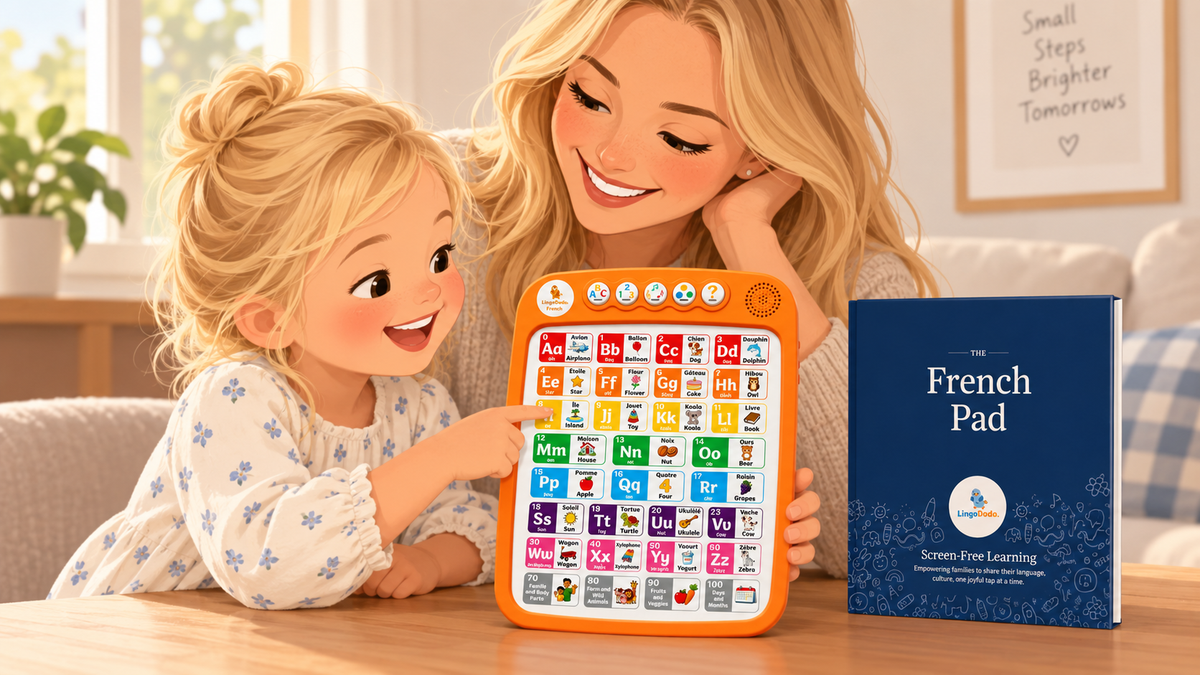

Raising a Bilingual Child at Home: How to Keep Spanish Alive When You're Busy
You want your child to grow up speaking Spanish. But between school pickups, homework, and work, finding the time to actually teach it can feel impossible. Here's the thing: you don't need hours. You need moments. Consistent, small, joyful moments that make Spanish feel like part of your family's normal life. The Biggest Obstacle for Bilingual Families Time pressure: Structured lessons take time most families don't have. English everywhere: TV, school, and friends all pull children toward English. Inconsistency: Starting and stopping is more damaging than slow progress. The families that succeed with bilingualism don't teach more. They integrate more. Spanish becomes part of the routine, not a subject. 5 Ways to Keep Spanish Alive in a Busy Household 1. The One-Language Rule for One Activity Pick one daily activity, like dinner, the car ride, or bath time, and make it Spanish-only. Even 10 to 15 minutes daily builds strong language habits over time. 2. Label Your Home in Spanish Post sticky notes around the house with Spanish words: la cocina (kitchen), la puerta (door), el baño (bathroom). Children absorb vocabulary just by seeing it repeatedly in context. 3. Sing During Transitions Spanish children's songs during car rides, getting dressed, or tidying up are surprisingly effective. Songs build rhythm, pronunciation, and memory in ways that drills never can. The more upbeat and fun the song, the more your child will ask to hear it again, and that repetition is exactly where language sticks. 4. Read One Book in Spanish at Bedtime Even if your Spanish is imperfect, reading aloud is one of the most powerful language tools available. Your child hears the sounds, sees the words, and connects with you, all at once. Start simple and don't worry about accent. 5. Skip the Cheap Alphabet Toy. Choose a Learning Device. Most parents try a $20 to $30 plastic alphabet board from Walmart or Costco. The child presses it a few times, it calls out a letter, and it ends up in a drawer within a week. Those toys are built to a price point, not built to teach a language. The Spanish Pad is a fundamentally different kind of tool. It's a premium, screen-free learning device built for families who take heritage language seriously. Here's what sets it apart: Rich, multi-word rhymes for every letter, each around 60 seconds long, upbeat, catchy, and beautifully produced. Each rhyme teaches several words that start with that letter, so your child builds a whole family of vocabulary, not just one word per letter. Kids beg to hear them again. Parents find themselves singing along too. Letter tracing built into every rhyme, a feature you won't find in LeapFrog or any other mass-market product. Each song teaches your child how to trace that letter, connecting the sound, the word, and the written form all in one experience. Capacitive finger-tap buttons like an iPhone. A light touch is all it takes, no pressing or mashing required. 5 levels of volume control so it works at breakfast, in the car, or during quiet time without waking the house. Covers alphabets, numbers, and colours plus a wide range of vocabulary categories: fruits, vegetables, days of the week, animals, family relationships, and body parts, all in Spanish and English. Built-in quiz mode so your child actively recalls and responds, not just listens passively. Arrives in a beautiful, Apple-like gift-ready box that customers rave about before their child even opens it. It feels like a learning device your child will reach for on their own, not a noisy toy you end up hiding. Final Thoughts Bilingualism isn't built in a classroom. It's built at the dinner table, in the car, at bedtime, and during play. The families who succeed are the ones who keep showing up, imperfectly, consistently, and with joy. Want to add a playful Spanish tool to your home? Explore the Spanish Pad, a premium, screen-free learning device your child will actually ask to use again.
Learn more
My Child Doesn't Speak Kannada: How to Start at Home Without Pressure
If your child understands Kannada but rarely speaks it, or doesn't speak it at all, you're not alone. Many Kannada-speaking families in the US, Canada, and UK face the same challenge. The good news is you don't need a classroom or a curriculum. You just need a few small, consistent habits at home and the right tools to make it stick. Why Kids Resist Speaking a Heritage Language Social comfort: English is the language of school, friends, and media. It feels easier and more natural. Fear of mistakes: Children (and adults!) often avoid speaking when they're not confident. Lack of opportunity: If Kannada isn't woven into daily routines, it stays passive. The goal isn't to force speaking. It's to make Kannada feel safe, natural, and worth using. 5 Ways to Get Kannada Going at Home 1. Start With One Kannada-Only Moment a Day You don't need Kannada all day. Just one consistent moment works. Breakfast, the drive to school, or bedtime are all perfect. Label it as "our Kannada time" without making it feel like homework. 2. Use Everyday Kannada Commands Slip Kannada naturally into normal requests instead of switching to English for convenience. "ಬಾ, ಊಟ ಮಾಡು." (Bā, ūṭa māḍu – Come, eat.) "ನೀರು ತಾ." (Nīru tā – Bring water.) "ಮಲಗು, ಶುಭ ರಾತ್ರಿ." (Malagu, śubha rātri – Sleep, good night.) These phrases feel like family, not lessons. 3. Tell Stories From Karnataka Folk tales from Karnataka, like stories from the Panchatantra, are a natural entry point. Tell them in Kannada and let your child ask questions in whichever language they're comfortable with. Over time, the Kannada will come. 4. Cook and Name Things in Kannada The kitchen is one of the best language classrooms. While making bisibelebath or ragi mudde, narrate in Kannada. "ಇದು ರಾಗಿ." (Idu rāgi – This is ragi.) "ಉಪ್ಪು ಹಾಕು." (Uppu hāku – Add salt.) 5. Choose a Learning Tool That Feels Like a Device, Not a Toy Here's where most families go wrong: they pick up a $20 to $30 English alphabet board from Walmart or Costco, the child presses it twice, and it ends up forgotten in a drawer. Those cheap plastic toys are loud, one-dimensional, and built to a price, not built to teach. The Kannada Pad is a different category of product entirely. It's a premium, screen-free learning device designed to feel like it belongs in the hands of a child who's used to quality. Here's what sets it apart: Capacitive finger-tap buttons like an iPhone, not a push-toy. A light tap is all it takes. No pressing, no mashing. 5 levels of volume control so it works at breakfast, in the car, or at quiet time without waking the house. Covers alphabets, numbers, and colours so your child builds real foundational vocabulary across multiple categories, not just ABCs. Built-in quiz mode so your child isn't just listening. They're actively recalling and responding. It's the difference between a learning device your child reaches for and a noisy toy you hide in a cupboard. Final Thoughts Your child doesn't need perfect Kannada. They need consistent Kannada. A word here, a phrase there, a story at bedtime, and a tool that makes vocabulary feel like play. Over months and years, those seeds grow into something real: a language that belongs to them. Ready to make Kannada part of your family's daily life? Explore the Kannada Pad, a premium, screen-free learning device built for families who want more than a cheap alphabet toy.
Learn more
Growing Up with Telugu: How to Build Strong Cultural Roots at Home
Why Telugu Matters For many families, Telugu is more than just a language. It’s the voice of lullabies, the rhythm of stories passed down from grandparents, and the taste of comfort food like pappu and pulihora. But in today’s world, English often takes over as the language of school, friends, and media. So how can parents keep Telugu alive at home, not just as words, but as part of their child’s identity? Here are some practical, heart-centered ways. Identity: Telugu connects children to who they are and where they come from. Family bonds: Grandparents and relatives often express love most deeply in Telugu. Cognitive benefits: Studies show bilingual children develop stronger problem-solving skills. Pride: Speaking Telugu helps children feel proud of their heritage, instead of feeling it’s something “old-fashioned.” 5 Ways to Keep Telugu Alive at Home 1. Storytelling Evenings Children remember stories more than lessons. Share folk tales like Tenali Ramakrishna or Bala Ramayanam in Telugu. Make it fun! Use voices, gestures, and even let your child “act out” the parts. 2. Telugu Through Food Cooking is a language classroom in disguise! While making dosa or pappu, talk in Telugu about the ingredients. Example:“ఉల్లిపాయ ఎక్కడ ఉంది?” (Where is the onion?)“ఇది మినప్పప్పు.” (This is urad dal.) 3. Music and Dance Telugu film songs, devotional songs, and folk dances like Kuchipudi are wonderful tools. Play them during car rides or have a weekend family “mini performance.” Kids absorb rhythm and words naturally. 4. Everyday Telugu Phrases Instead of switching to English for convenience, use simple Telugu commands or phrases daily. “రా, భోజనం తిను.” (Come, eat dinner.) “బయట ఆడు.” (Play outside.) “శుభరాత్రి.” (Good night.) Small phrases become habits that stick. 5. Screen-Free Language Tools Children learn best through play. Interactive, hands-on tools like the Telugu Pad bring everyday vocabulary to life without screens. It’s not about memorization. It’s about making Telugu fun and part of your child’s natural world. Final Thoughts Keeping Telugu alive at home doesn’t require hours of teaching. It’s about weaving the language into daily life, stories, meals, music, play, and love. Each word your child hears and speaks in Telugu is a seed planted for cultural pride and connection. And if you’d like a little extra support, explore our Telugu Pad: a playful, screen-free way to help your child fall in love with their mother tongue.
Learn more
Teaching Gujarati When You Understand More Than You Speak
Many parents want their children to grow up speaking Gujarati, but what if you understand Gujarati well, yet struggle to speak it yourself? You’re not alone. This is a common situation for second-generation families, and the good news is: you can still raise a child who speaks Gujarati. Why This Challenge Happens Generational shift: You may have grown up hearing Gujarati from your parents or grandparents but used English at school. Confidence gap: You understand meaning, but forming sentences feels slow or awkward. Perfection trap: Parents sometimes avoid speaking for fear of making mistakes. The truth is, your child doesn’t need “perfect” Gujarati from you. They need consistency, exposure, and encouragement. 5 Practical Ways to Teach Gujarati 1. Speak What You Know — Consistently Even if it’s just a few phrases, use them daily. Repetition is powerful. Examples: “બેસો” (beso – sit down) “ખાઓ” (khāo – eat) “પાણી” (pāṇī – water) Your child learns from hearing the same words in natural settings. 2. Narrate in Gujarati + English If you know the Gujarati word, use it. If not, continue in English. Over time, you’ll learn together. Example at the park: “જુઓ, આ બર્ડ છે.” (Juō, ā bird che. – Look, this is a bird.) “તે ઊડી રહ્યો છે.” (Te ūḍī rahyo che. – It is flying.) This shows your child that Gujarati is part of normal speech, even when mixed. Learn Together With Your Child Turn the challenge into teamwork. Use flashcards, storybooks, or screen-free toys like the Gujarati Pad to explore vocabulary side by side. Kids love when parents say, “Let’s learn this together.” 4. Involve Fluent Relatives or Community Grandparents, cousins, or family friends can be invaluable. Encourage them to speak only Gujarati with your child. Even short weekly calls can build confidence. 5. Celebrate Progress, Not Perfection If your child replies in Gujarati, celebrate it, even if the grammar isn’t perfect. When you respond with joy, your child feels encouraged to keep trying. Final Thoughts You don’t need flawless Gujarati to give your child the gift of the language. By using the words you know, mixing English when needed, learning alongside your child, and involving community support, you create an environment where Gujarati feels alive and natural. Over time, you’ll improve together, and your child will carry the language forward with confidence. 👉 Ready to make Gujarati playful? Explore our Gujarati Pad and Dikku the Gujarati Elephant — screen-free companions designed to help families just like yours.
Learn more
My Child Answers in English: How to Keep Punjabi Going at Home
Every parent teaching Punjabi at home knows the moment: you speak in Punjabi, and your child answers in English. It can feel frustrating, but it’s normal. Children naturally lean toward the majority language they hear at school, from friends, or on TV. The good news is, there are simple strategies you can use every day to keep Punjabi alive and active in your home. Why Kids Switch to English Comfort zone: English becomes the default once school starts. Peer pressure: Kids want to fit in with classmates. Effort factor: Answering in Punjabi feels like extra work. This doesn’t mean your child is rejecting Punjabi. It’s simply easier for them. Your role is to make Punjabi equally easy and fun. 5 Strategies That Work 1. Stick With Punjabi (Even When They Reply in English) If your child answers in English, keep the conversation in Punjabi. Over time, this sets the expectation that Punjabi is part of family communication. ExampleParent: “ਤੂੰ ਖਾਣਾ ਖਾ ਲਿਆ?” (Did you eat?)Child: “Yes.”Parent: “ਚੰਗਾ, ਕੀ ਖਾਧਾ?” (Good, what did you eat?) You’re not scolding, just modeling consistency. 2. Create Daily Punjabi Routines Link Punjabi to specific times of day. For example: Breakfast = Punjabi only Car rides = Punjabi songs Bedtime = Punjabi story These little routines add up and make language use automatic. 3. Use Prompts, Not Quizzes Instead of asking your child to “say this in Punjabi,” try using natural prompts. Try this at mealtime: “ਆਲੂ ਕਿੱਥੇ ਹਨ?” (Where are the potatoes?) “ਕੀ ਤੈਨੂੰ ਪਾਣੀ ਚਾਹੀਦਾ ਹੈ?” (Do you want water?) These feel like real conversations, not tests. 4. Make Punjabi Playful Children learn best when they’re having fun. Use toys, songs, and playful tools. Act out actions: ਦੌੜਨਾ, ਛਾਲ ਮਾਰਨਾ, ਹੱਸਣਾ (run, jump, laugh). Sing classic rhymes in Punjabi. Use screen-free interactive toys like the Punjabi Pad or Babbu the Punjabi Elephant to make language practice feel like play. 5. Celebrate Every Word Even one Punjabi word in an English sentence is progress. Praise it. Over time, single words grow into phrases and full sentences. Final Thoughts Language isn’t learned overnight. It’s built through small, joyful interactions repeated every day. If your child answers in English, don’t worry, just keep Punjabi alive in your routines, in your play, and in your heart. And if you’d like a helping hand, explore our Punjabi Pad and Babbu the Punjabi Elephant : playful, screen-free companions designed to keep Punjabi alive at home.
Learn more
Discover the Magic of Interactive Language Learning Toys - Preserving Cultural Identity in Gujarati, Hindi, Punjabi, Tamil, Telugu, and Malayalam
In a globalized world where cultural diversity is celebrated, bilingualism becomes a bridge between the past and the future. It's a testament to the enduring legacy of cultural identity and the importance of preserving it for generations to come.
Learn more
Bilingual Bonds: Expanding Social Connections
Imagine attending multicultural gatherings or international events and being able to engage in conversations with ease. Bilingualism allows you to bridge gaps and create meaningful connections with individuals from diverse cultures.
Learn more
Bilingual Adventures: Enriching Travel Experiences
It's not just about words; it's about opening your heart to the world and forging connections that make your journeys truly unforgettable. Bilingualism is your passport to richer, more immersive travel experiences, where every conversation becomes an adventure in itself.
Learn more
Bilingual Brilliance: Building Cognitive Reserve
Research suggests that bilingualism may delay the onset of age-related cognitive decline by several years. The cognitive advantages developed through bilingualism, such as better problem-solving skills and mental flexibility, provide a buffer against cognitive decline.
Learn more