

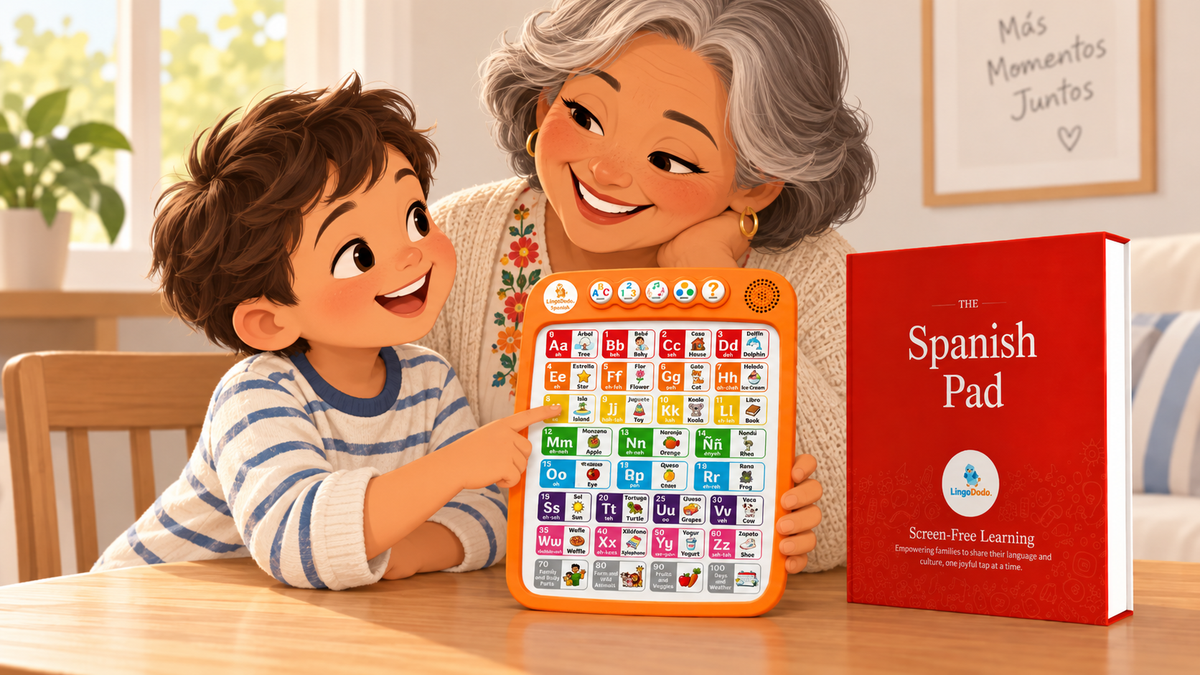
You want your child to grow up speaking Spanish. But between school pickups, homework, and work, finding the time to actually teach it can feel impossible. Here's the thing: you don't need hours. You need moments. Consistent, small, joyful moments that make Spanish feel like part of your family's normal life.
The Biggest Obstacle for Bilingual Families
- Time pressure: Structured lessons take time most families don't have.
- English everywhere: TV, school, and friends all pull children toward English.
- Inconsistency: Starting and stopping is more damaging than slow progress.
The families that succeed with bilingualism don't teach more. They integrate more. Spanish becomes part of the routine, not a subject.
5 Ways to Keep Spanish Alive in a Busy Household
1. The One-Language Rule for One Activity
Pick one daily activity, like dinner, the car ride, or bath time, and make it Spanish-only. Even 10 to 15 minutes daily builds strong language habits over time.
2. Label Your Home in Spanish
Post sticky notes around the house with Spanish words: la cocina (kitchen), la puerta (door), el baño (bathroom). Children absorb vocabulary just by seeing it repeatedly in context.
3. Sing During Transitions
Spanish children's songs during car rides, getting dressed, or tidying up are surprisingly effective. Songs build rhythm, pronunciation, and memory in ways that drills never can. The more upbeat and fun the song, the more your child will ask to hear it again, and that repetition is exactly where language sticks.
4. Read One Book in Spanish at Bedtime
Even if your Spanish is imperfect, reading aloud is one of the most powerful language tools available. Your child hears the sounds, sees the words, and connects with you, all at once. Start simple and don't worry about accent.
5. Skip the Cheap Alphabet Toy. Choose a Learning Device.
Most parents try a $20 to $30 plastic alphabet board from Walmart or Costco. The child presses it a few times, it calls out a letter, and it ends up in a drawer within a week. Those toys are built to a price point, not built to teach a language.
The Spanish Pad is a fundamentally different kind of tool. It's a premium, screen-free learning device built for families who take heritage language seriously. Here's what sets it apart:
- Rich, multi-word rhymes for every letter, each around 60 seconds long, upbeat, catchy, and beautifully produced. Each rhyme teaches several words that start with that letter, so your child builds a whole family of vocabulary, not just one word per letter. Kids beg to hear them again. Parents find themselves singing along too.
- Letter tracing built into every rhyme, a feature you won't find in LeapFrog or any other mass-market product. Each song teaches your child how to trace that letter, connecting the sound, the word, and the written form all in one experience.
- Capacitive finger-tap buttons like an iPhone. A light touch is all it takes, no pressing or mashing required.
- 5 levels of volume control so it works at breakfast, in the car, or during quiet time without waking the house.
- Covers alphabets, numbers, and colours plus a wide range of vocabulary categories: fruits, vegetables, days of the week, animals, family relationships, and body parts, all in Spanish and English.
- Built-in quiz mode so your child actively recalls and responds, not just listens passively.
- Arrives in a beautiful, Apple-like gift-ready box that customers rave about before their child even opens it.
It feels like a learning device your child will reach for on their own, not a noisy toy you end up hiding.
Final Thoughts
Bilingualism isn't built in a classroom. It's built at the dinner table, in the car, at bedtime, and during play. The families who succeed are the ones who keep showing up, imperfectly, consistently, and with joy.
Want to add a playful Spanish tool to your home? Explore the Spanish Pad, a premium, screen-free learning device your child will actually ask to use again.

