

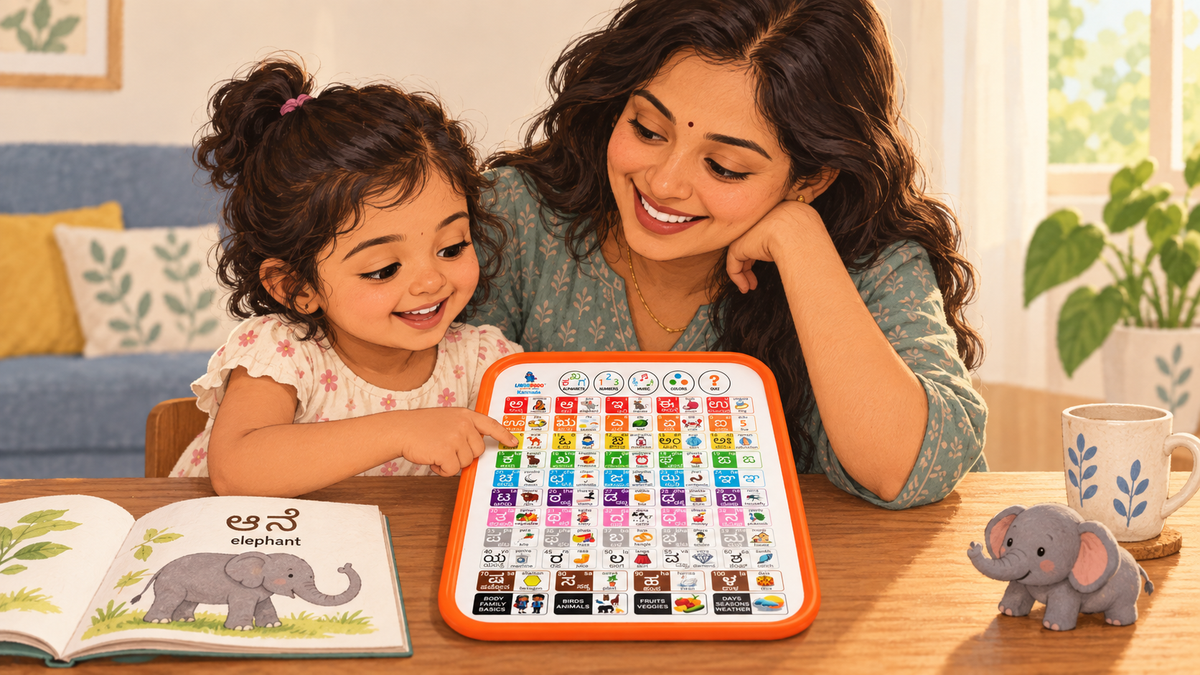
If your child understands Kannada but rarely speaks it, or doesn't speak it at all, you're not alone. Many Kannada-speaking families in the US, Canada, and UK face the same challenge. The good news is you don't need a classroom or a curriculum. You just need a few small, consistent habits at home and the right tools to make it stick.
Why Kids Resist Speaking a Heritage Language
- Social comfort: English is the language of school, friends, and media. It feels easier and more natural.
- Fear of mistakes: Children (and adults!) often avoid speaking when they're not confident.
- Lack of opportunity: If Kannada isn't woven into daily routines, it stays passive.
The goal isn't to force speaking. It's to make Kannada feel safe, natural, and worth using.
5 Ways to Get Kannada Going at Home
1. Start With One Kannada-Only Moment a Day
You don't need Kannada all day. Just one consistent moment works. Breakfast, the drive to school, or bedtime are all perfect. Label it as "our Kannada time" without making it feel like homework.
2. Use Everyday Kannada Commands
Slip Kannada naturally into normal requests instead of switching to English for convenience.
- "ಬಾ, ಊಟ ಮಾಡು." (Bā, ūṭa māḍu – Come, eat.)
- "ನೀರು ತಾ." (Nīru tā – Bring water.)
- "ಮಲಗು, ಶುಭ ರಾತ್ರಿ." (Malagu, śubha rātri – Sleep, good night.)
These phrases feel like family, not lessons.
3. Tell Stories From Karnataka
Folk tales from Karnataka, like stories from the Panchatantra, are a natural entry point. Tell them in Kannada and let your child ask questions in whichever language they're comfortable with. Over time, the Kannada will come.
4. Cook and Name Things in Kannada
The kitchen is one of the best language classrooms. While making bisibelebath or ragi mudde, narrate in Kannada.
- "ಇದು ರಾಗಿ." (Idu rāgi – This is ragi.)
- "ಉಪ್ಪು ಹಾಕು." (Uppu hāku – Add salt.)
5. Choose a Learning Tool That Feels Like a Device, Not a Toy
Here's where most families go wrong: they pick up a $20 to $30 English alphabet board from Walmart or Costco, the child presses it twice, and it ends up forgotten in a drawer. Those cheap plastic toys are loud, one-dimensional, and built to a price, not built to teach.
The Kannada Pad is a different category of product entirely. It's a premium, screen-free learning device designed to feel like it belongs in the hands of a child who's used to quality.
Here's what sets it apart:
- Capacitive finger-tap buttons like an iPhone, not a push-toy. A light tap is all it takes. No pressing, no mashing.
- 5 levels of volume control so it works at breakfast, in the car, or at quiet time without waking the house.
- Covers alphabets, numbers, and colours so your child builds real foundational vocabulary across multiple categories, not just ABCs.
- Built-in quiz mode so your child isn't just listening. They're actively recalling and responding.
It's the difference between a learning device your child reaches for and a noisy toy you hide in a cupboard.
Final Thoughts
Your child doesn't need perfect Kannada. They need consistent Kannada. A word here, a phrase there, a story at bedtime, and a tool that makes vocabulary feel like play. Over months and years, those seeds grow into something real: a language that belongs to them.
Ready to make Kannada part of your family's daily life? Explore the Kannada Pad, a premium, screen-free learning device built for families who want more than a cheap alphabet toy.

