

Telugu is one of India's most widely spoken languages, rich in literature, classical music, and cultural tradition. For Telugu-speaking families in the US, Canada, Australia, or the UK, the challenge is familiar: how do you raise a child who genuinely speaks Telugu when English fills every waking hour?
The answer is presence. Telugu has to show up at home, in daily conversation, in celebration, and in play, consistently enough that your child starts to feel it as theirs.
Why Telugu Drifts Away Without Effort
- The script is complex: Telugu has one of the largest alphabets of any Indian language. Parents who speak it fluently may feel unequipped to teach it, so they don't start.
- Almost no children's resources abroad: Quality Telugu learning materials for young children are extremely rare outside Andhra Pradesh and Telangana.
- English is simply easier: For a child growing up in an English-speaking country, Telugu requires deliberate encouragement to stay active.
But Telugu rewards that effort with one of the most expressive, melodically rich languages your child could grow up speaking.
5 Ways to Bring Telugu Into Daily Life
1. Use Telugu for the Rhythms of the Day
Morning wake-up, mealtimes, and bedtime are the three most consistent language opportunities every day. Use them in Telugu. "Levu, levu" (Wake up). "Tinu" (Eat). "Paduko" (Sleep). Small, repeated phrases across years become the bedrock of a heritage language.
2. Name the World Around Your Child in Telugu
Point at things and name them. The sky, the rain, the dog, the fruit bowl, the vegetables while cooking. Children build vocabulary through repetition in context, not through sitting down to study. Telugu names for everyday things, used casually and consistently, add up faster than parents expect.
3. Cook Telugu Food and Talk While You Cook
Pesarattu, pulihora, gulab jamun, gongura pachadi: the kitchen is one of the richest Telugu vocabulary environments available. Narrate what you're doing. Name the ingredients. Ask your child to pass things using Telugu words. Food memory and language memory are deeply connected.
4. Celebrate Telugu Culture Loudly and Joyfully
Ugadi, Sankranti, and Bathukamma are not just festivals. They are language immersion opportunities. Explain each ritual in Telugu. Sing the songs. Let your child hear Telugu used in contexts of joy, color, and family, and they'll associate the language with exactly that.
5. Give Telugu a Learning Tool Unlike Anything Your Child Has Ever Heard
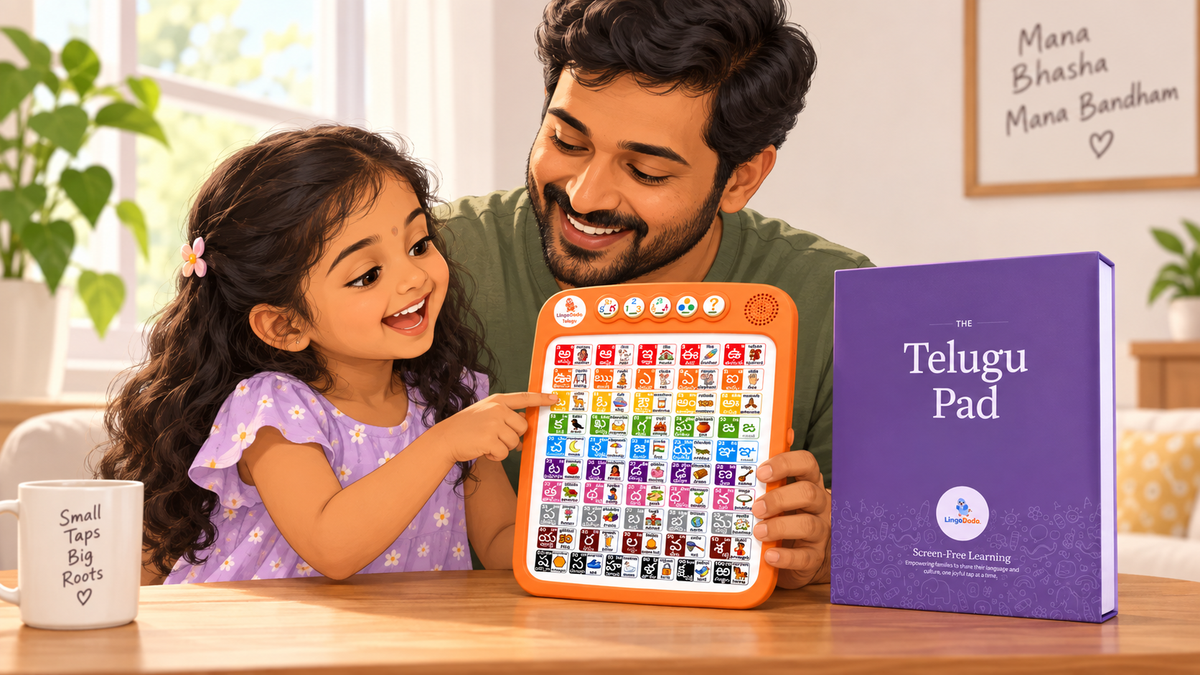
Telugu has one of the richest alphabets of any Indian language, with dozens of letters, each carrying its own sound and shape. The Telugu Pad Next-Gen has an original, studio-quality rhyme for every single one of them. That's an enormous creative undertaking, hundreds of hours of original production, and it shows.
But what will truly surprise Telugu parents is the sound. These are not the gentle, traditional rhymes you might expect. The rhymes on the Telugu Pad blend modern Western beats with Telugu lyrics in a way that has never been done for a children's learning product before. Parents who grew up with Telugu children's songs will do a double take. "O ante Okati, O ante Onte" plays with the letter O in a way that's clever, rhythmic, and genuinely fun. The beloved "Uduta uduta ooch" gets a modern production that makes it feel completely fresh while staying rooted in what Telugu families know and love. These are the kinds of rhymes children ask to hear again, and again, and again.
Capacitive finger-tap buttons respond to a light touch, just like an iPhone. Five levels of volume control work for any time of day. A built-in quiz mode keeps your child actively recalling rather than just listening. And it arrives in a beautifully designed, Apple-like gift-ready box that reflects the extraordinary effort that went into everything inside.
Final Thoughts
Telugu is a language with centuries of poetry, music, and culture behind it. Your child is the next link in that chain. They don't need to move to Hyderabad to feel connected to it. They just need it at home, every day, in small doses, with tools worthy of the language.
Explore the Telugu Pad Next-Gen, a screen-free learning device with original Telugu rhymes unlike anything your child has heard before, built for families who refuse to let the language fade.

