

For Filipino families living in the US, Canada, or elsewhere abroad, there's a moment many parents describe: their child looks at them blankly when spoken to in Tagalog, and something quietly breaks. The language of home, of lola and lolo, of childhood songs and fiestas, is slipping away one English sentence at a time.
It doesn't have to go that way. Filipino is a warm, expressive, deeply singable language, and children respond to it when it's made joyful and consistent at home.
Why Tagalog Fades So Quickly Abroad
- English is everywhere: School, friends, and screens are entirely in English. Filipino only survives at home if it's actively kept there.
- Children mirror their environment: If English is easier and faster, young children will default to it unless Filipino is made equally natural and rewarding.
- Resources are limited: Quality Filipino learning materials for young children are genuinely hard to find outside the Philippines.
But here's what every Filipino parent already has that no curriculum can teach: the songs, the rhymes, and the warmth that make Tagalog feel like home.
5 Ways to Keep Filipino Alive at Home
1. Make Tagalog the Language of Counting
Start with numbers. "Isa, dalawa, tatlo" is one of the first things Filipino children learn, and it sticks because of its rhythm. Count steps on the stairs, pieces of food on the plate, fingers at bedtime. Counting in Filipino is one of the easiest and most natural bridges into the language.
2. Bring Back Bahay Kubo
"Bahay Kubo" is more than a children's song. It's a vocabulary lesson, a celebration of Filipino food and nature, and a piece of cultural memory that Filipino adults carry their whole lives. Sing it while cooking. Play it in the car. Let your child hear it often enough that they start singing along without being asked. That moment, when they sing it on their own, is the moment Filipino takes root.
3. Use Tagalog for Daily Instructions
Swap everyday English commands for Filipino ones and keep them consistent.
- "Kain na." (Time to eat.)
- "Matulog na." (Time to sleep.)
- "Halika." (Come here.)
- "Salamat." (Thank you.)
Children learn the words they hear most. Make these the words they hear every day.
4. Connect With Lola, Lolo, and the Extended Family in Filipino
Video calls with family in the Philippines are one of the most powerful Filipino learning tools available. Set an expectation that Filipino is the language for those calls. Children rise to the occasion when love is on the other end of the screen, and grandparents light up when a grandchild speaks to them in their language.
5. Give Filipino a Learning Tool That Knows the Songs Your Child Needs to Hear
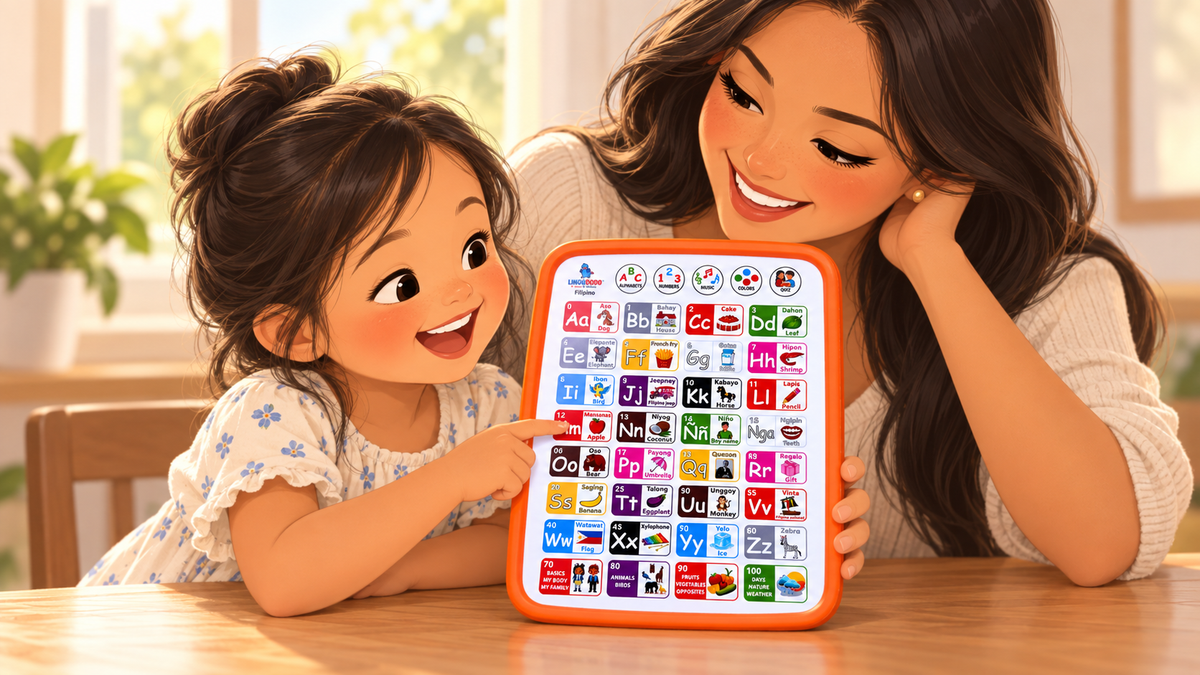
The Filipino Pad was built for exactly this: Filipino families abroad who want their children to grow up knowing the language, the songs, and the vocabulary of home.
Press A in Music Mode and the entire Filipino alphabet comes to life in one flowing rhyme: A A Aso, B B Bahay, letter by letter, each one paired with a familiar Filipino word, all the way through the alphabet. It's an immersive experience from a single button press, and children want to go through the whole thing just to hear what comes next.
Press B and "Bahay Kubo" fills the room, the beloved song about vegetables and the simple Filipino home that every parent and grandparent knows by heart. The counting song "Isa, dalawa, tatlo" is there too, with the rhythm and warmth that makes numbers in Filipino feel like play rather than study.
Beyond the songs, the Pad covers a wide range of vocabulary categories: fruits, vegetables, animals, family relationships, body parts, and more, all in Filipino and English. A built-in quiz mode keeps your child actively recalling and responding rather than just pressing and listening.
Parents who hear it for the first time often smile before they even realize it. That's what familiar songs in a beloved language do. And that's exactly what you want your child to feel.
Final Thoughts
Filipino is a language full of warmth, music, and heart. Your child doesn't need to be in Manila to fall in love with it. They just need it to be present at home, in the songs you sing, the words you use, and the tools you put in their hands.
Explore the Filipino Pad, a screen-free learning device built for Filipino families who want their children to grow up knowing where they come from and loving the language that carries it.

